Canadian Shoe Size to US: Are They the Same?
Canadian shoe sizes are the same as US sizes. Men's and women's charts with UK, EU and foot length, plus tips on brands and winter boots.
Quick answer
Canadian shoe sizes are the same as US sizes, men's and women's, so there is nothing to convert: a Canadian 9 is a US 9. You only convert when a label uses UK or EU numbers. Fit still differs by brand, so check the brand's notes and match your foot length in centimeters.
Canadian shoe sizes are the same as US shoe sizes. A men's 9 in Toronto is a men's 9 in Chicago, and a women's 7 is a women's 7 on both sides of the border. There is nothing to add, subtract or convert. If a pair is labeled with a US size and a CA size, the two numbers will match.
That does not mean every shoe fits the same, because brands and lasts differ, and that is where most Canadian buyers get tripped up. This page gives you the shared chart with UK and EU equivalents, foot length in centimeters, and a practical guide to the places where an identical number still lands differently.
One scale, two countries
Canada and the United States share the same footwear numbering for adults and children. Men's and women's scales remain separate, and women's numbers run higher than men's for the same foot. A woman's 8 and a man's 6.5 are the same foot length on the standard chart, 24.1 cm.
The only time you need to convert is when the label uses another scale, such as UK or EU numbers on a European or British brand. The tables below cover those columns too.
Men's chart
Use this table when you know your US or Canadian number and want the UK and EU labels, or when you know your foot length and want the number. The foot length column is the real length of the foot that size fits. The CM (JP) column is the label on the box, which includes toe room, so it reads higher.
| US / CA men's | UK | EU | Foot length (cm) | CM (JP) |
|---|---|---|---|---|
| 6 | 5.5 | 38.5 | 23.7 | 24 |
| 6.5 | 6 | 39 | 24.1 | 24.5 |
| 7 | 6 | 40 | 24.6 | 25 |
| 7.5 | 6.5 | 40.5 | 24.9 | 25.5 |
| 8 | 7 | 41 | 25.4 | 26 |
| 8.5 | 7.5 | 42 | 25.9 | 26.5 |
| 9 | 8 | 42.5 | 26.2 | 27 |
| 9.5 | 8.5 | 43 | 26.7 | 27.5 |
| 10 | 9 | 44 | 27.1 | 28 |
| 10.5 | 9.5 | 44.5 | 27.5 | 28.5 |
| 11 | 10 | 45 | 27.9 | 29 |
| 11.5 | 10.5 | 45.5 | 28.4 | 29.5 |
| 12 | 11 | 46 | 28.7 | 30 |
| 12.5 | 11.5 | 47 | 29.2 | 30.5 |
| 13 | 12 | 47.5 | 29.7 | 31 |
| 14 | 13 | 48.5 | 30.5 | 32 |
| 15 | 14 | 49.5 | 31.3 | 33 |
Women's chart
The women's scale uses the same approach. If you are shopping a men's or unisex shoe, the foot-length column is the safest way to translate: find your foot, then read the men's row. For the numbers themselves, see our men's to women's size guide.
| US / CA women's | UK | EU | Foot length (cm) | CM (JP) |
|---|---|---|---|---|
| 5 | 2.5 | 35.5 | 21.6 | 22 |
| 5.5 | 3 | 36 | 22.0 | 22.5 |
| 6 | 3.5 | 36.5 | 22.4 | 23 |
| 6.5 | 4 | 37.5 | 22.9 | 23.5 |
| 7 | 4.5 | 38 | 23.3 | 24 |
| 7.5 | 5 | 38.5 | 23.7 | 24.5 |
| 8 | 5.5 | 39 | 24.1 | 25 |
| 8.5 | 6 | 40 | 24.6 | 25.5 |
| 9 | 6.5 | 40.5 | 24.9 | 26 |
| 9.5 | 7 | 41 | 25.4 | 26.5 |
| 10 | 7.5 | 42 | 25.9 | 27 |
| 10.5 | 8 | 42.5 | 26.2 | 27.5 |
| 11 | 8.5 | 43 | 26.7 | 28 |
| 12 | 9.5 | 44.5 | 27.5 | 29 |
Fit tip: A 24.1 cm foot is a women's 8 and a men's 6.5. If you are cross-shopping, match the foot length, not the number on the box. Many mix-ups come from assuming a women's 8 is a men's 8.
When the same number fits differently
Because the scale is shared, any Canadian online order of a US brand needs only your usual number. Fit differences come from the shoe itself. These are the common patterns, described as consensus rather than measured results.
- Nike. Many wearers find it snug, especially in the toe box. Fit varies by model, so check notes for the exact pair.
- Adidas. Generally described as roomier than Nike, with a different UK-based scale, which is why its EU numbers can look odd.
- Converse Chuck Taylors. Widely reported to run big: most people go down half a size, and some go down a full size. This does not carry over to other brands.
- New Balance. Fits differently from Converse, and different models vary. Check the model before assuming.
The point is simple. A shared number gets you to the right neighborhood and the brand's last decides the rest. If you wear a 10 in one brand, do not take a 10 in another without checking its notes.
Buying from US sites as a Canadian
US retailers show US sizes, so you can order your usual number. Three practical points apply.
- Check the return policy for cross-border orders. Return shipping and duties can cost more than the shoes. Some stores run a separate Canadian site with local returns, so check before you pick a store.
- Do not rely on a size chart that shows only the US column. If the chart also shows foot length, use that to confirm you are in the right row.
- Read fit reviews for the exact model. Reviews from other shoppers who give their usual size are more useful than a general conversion table.
Buying UK or European brands in Canada
Here you do need a conversion. UK numbers are one lower than US for men and about 2.5 lower for women on our chart. Our UK to US guide covers the offsets and where brands disagree, and the same logic applies to European numbers. For EU sizes, remember that brands round differently, so one EU 42 can sit a few millimeters from the next. Use the foot-length column as the tie-breaker.
If you are between two conversions, pick the one that gives you more room at the toe for sneakers, boots and running shoes. Too short is harder to fix than a little loose.
Kids' and baby shoe sizes
Children's sizes also match between Canada and the US. Kids' numbers start over after 13, so a children's size 1 is larger than a children's 13, and a baby's size 3 bears no relation to an adult 3. Do not use the adult tables for children. Find a kids' chart from the brand and match the foot length, and leave growing room. The usual advice is a thumb's width in front of the longest toe, checked often because small feet change quickly.
Winter boots: size with the socks you will wear
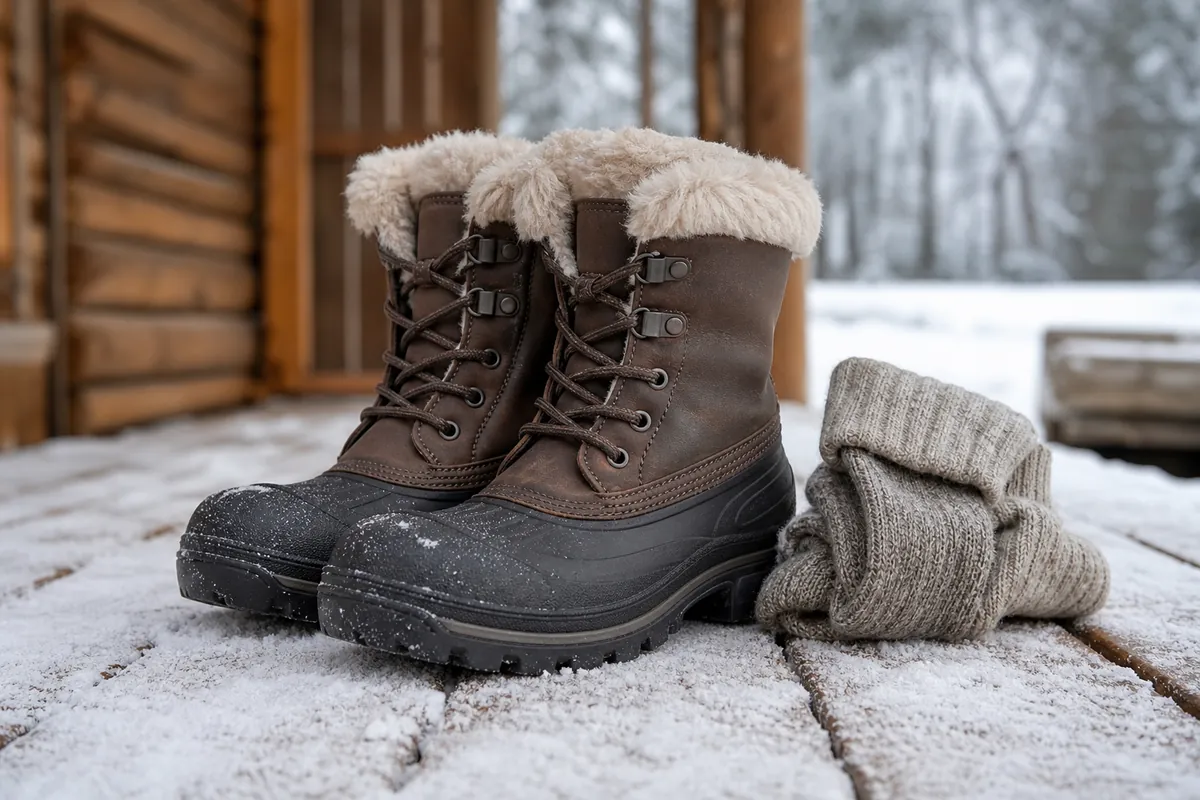
Canadian winters bring a fit problem that charts do not solve: the thick sock. A boot that fits perfectly over a thin sock may feel tight with wool, and a boot with removable liners behaves differently from one with a built-in lining. Try boots with the socks you will actually use, and leave enough room for the toes to move so that circulation is not cut off. Our guide to how winter boots should fit covers this, including heel hold and toe space.
Fit tip: If your toes cannot wiggle in a winter boot, the boot is too tight for cold weather, whatever the number says. Compression reduces warmth, so a slightly roomier size is a better choice than a snug one.
Measuring your feet in Canada
Canadian shoppers think in centimeters, which is convenient, because the charts above work in centimeters. Here is the short version of how to measure.
- Trace both feet on paper while standing, and measure heel to longest toe.
- Measure the widest point across the ball as well, since width affects which model suits you.
- Measure in the evening, when feet are largest. Feet swell during the day.
- Use the longer foot, and re-measure now and then. Weight changes, pregnancy, aging and injury can all change foot size or shape.
Many stores also have a Brannock device, which reads length, width and arch length. If you can, use one when buying shoes in person, then keep your numbers for online orders. Our full guide to measuring your feet covers both methods.
Fit checks that apply anywhere
Once you have the number, the same checks apply on any chart: leave about a thumb's width between your longest toe and the front of the shoe, keep the heel snug without slipping or digging in, try shoes with the socks you plan to wear, and walk around before deciding. If the length is right but the shoe pinches at the sides, you need a wider or less tapered model, not a longer size.
Why people think Canada is different
The confusion usually comes from three places. First, Canadian stores sell many UK and European brands, and those labels carry UK or EU numbers, so a shopper sees three numbers on one box and wonders which is "Canadian". The answer is the US one. Second, French-language listings use the word pointure for size, but the numbers behind it are the same. Third, some websites publish a separate "Canada" column that is simply a copy of the US column, which makes it look like a conversion when it is not.
Three quick examples
A man in Vancouver wears a size 10 and orders a UK brand. His foot is about 27.1 cm. On the UK scale that is a 9, so he should order a UK 9, which is also an EU 44.
A woman in Montreal wears an 8 and wants a men's sneaker. Her foot is about 24.1 cm, so the same foot is a men's 6.5. If the shoe is only sold in men's sizes and she is between 6.5 and 7, she should read the brand's own notes on whether the shoe runs long.
A parent in Calgary is buying a pair of kids' boots. The child's longer foot is measured, not their last size. Because kids' scales restart after 13, an adult chart would mislead, so the parent uses the brand's kids' chart and leaves room for growth, checking again every few months.
Half sizes and width
A half size is about 4 mm of length, so a mistake of half a size is small on paper and noticeable on the foot. If your measurement falls between two rows, take the larger for athletic shoes and winter boots. Width is a separate question. Many Canadian retailers carry wide fittings in boots and work shoes, and the letter codes follow US practice, with D standard for men and B standard for women. The letter codes are worth learning before you order online.
Quick reference
- Canada to US: same number, men's and women's.
- UK to US for men: add 1. Women's: add about 2.5 on our chart.
- Foot length 26.2 cm: men's 9 (UK 8, EU 42.5).
- Foot length 24.1 cm: women's 8 (UK 5.5, EU 39) and men's 6.5.
- Any doubt: foot length in centimeters.
Bottom line
You do not convert Canadian shoe sizes to US because they are the same scale. What you do need is the right row for your foot and some care about brands. The shoe size calculator and the shoe size conversion chart will give you the UK, EU and CM (JP) labels for any US or Canadian number.
Frequently asked questions
Is a Canadian size 8 the same as a US 8?
Yes. Canada and the US use the same numbers for men's, women's and children's shoes. A women's 8 is a UK 5.5 and an EU 39, and fits a foot of about 24.1 cm on our standard chart.
Do I need to convert sizes when ordering from US stores?
No. Order your usual number. What deserves attention is the brand: some run snug or big. Also check the return policy for cross-border orders, since return shipping and duties can cost more than the shoes.
How do I convert a UK size to Canadian?
Use the US rule, since Canada matches US. For men's shoes add 1 to the UK number, so UK 8 is a 9. For women's shoes add about 2.5 on our chart, so UK 5.5 is an 8. Some brands differ, so check their chart.
Are Canadian kids' shoe sizes the same as US?
Yes, the numbers match. Kids' sizes restart after 13, so a children's 1 is larger than a children's 13. Use a kids' chart and match the longer foot's length, leaving growing room.
Why does the same size fit differently at different brands?
A size label is a rough category. Each brand builds on its own last and rounds foot length differently, so a 10 in one brand can feel snug or roomy in another. Check fit notes for the model.