Men's to Women's Shoe Size Conversion: Rules by Brand
Add 1.5 to a men's size for Nike, New Balance and Asics, or 1 for Adidas. Tables built from real charts, plus UK/EU notes and worked examples.
Quick answer
To convert men's to women's US shoe size, add 1.5 for Nike, New Balance and Asics, and add 1 for Adidas. To go from women's to men's, subtract the same amount. A men's 9 is a women's 10.5 in Nike, 10 in Adidas. UK and EU sizes are unisex, so those numbers do not change.
To convert a men's US shoe size to women's, add 1.5 at Nike, New Balance and Asics, and add 1 at Adidas. To go the other way, subtract the same amount. A men's 9 is a women's 10.5 in a Nike, and a women's 10 in an Adidas. UK and EU sizes are unisex, so those numbers stay the same on either side.
The rules are simple, but the details trip people up: half sizes that do not exist, brands that quote a slightly different gap, and unisex models where only one scale appears on the box. This guide gives you the rules, tables built from our size data, worked examples and the exceptions to watch for.
| Brand | Rule | Example: men's 9 is women's |
|---|---|---|
| Nike | Add 1.5 | 10.5 |
| New Balance | Add 1.5 | 10.5 |
| Asics | Add 1.5 | 10.5 |
| Adidas | Add 1 | 10 |
Why men's and women's sizes differ
US shoe sizes were never a single scale. Men's and women's ranges began separately, and the two numbers were later lined up with an offset. The result is a gap of about one to one and a half sizes depending on who is doing the conversion.
Brands also build women's shoes on narrower lasts. A women's version of a sneaker is not just a relabeled men's version: the heel, midfoot and forefoot can be cut slimmer. That is the reason a women's shoe in the matching length can feel tighter across the sides.
Convert a men's size to women's
Use the Nike-style rule of +1.5 for Nike, New Balance and Asics. The table below shows men's sizes with their women's equivalents. The UK and EU columns come from the men's row of our standard chart and apply on both sides.
| Men's US | Women's US | UK | EU |
|---|---|---|---|
| 6 | 7.5 | 5.5 | 38.5 |
| 6.5 | 8 | 6 | 39 |
| 7 | 8.5 | 6 | 40 |
| 7.5 | 9 | 6.5 | 40.5 |
| 8 | 9.5 | 7 | 41 |
| 8.5 | 10 | 7.5 | 42 |
| 9 | 10.5 | 8 | 42.5 |
| 9.5 | 11 | 8.5 | 43 |
| 10 | 11.5 | 9 | 44 |
| 10.5 | 12 | 9.5 | 44.5 |
| 11 | 12.5 | 10 | 45 |
| 11.5 | 13 | 10.5 | 45.5 |
| 12 | 13.5 | 11 | 46 |
| 12.5 | 14 | 11.5 | 47 |
| 13 | 14.5 | 12 | 47.5 |
Runner's tip: Men's and women's rows share a UK and EU number in most places. A men's 8.5 is a UK 7.5 and an EU 42, and so is a women's 10. Using UK or EU as your anchor avoids the arithmetic.
Convert a women's size to men's
Subtract 1.5. A women's 9.5 is a men's 8, and a women's 11 is a men's 9.5. If the result lands on a size that does not exist, such as a men's 5, pick the nearest real size and check the foot length.
| Women's US | Men's US | UK | EU |
|---|---|---|---|
| 7.5 | 6 | 5 | 38.5 |
| 8 | 6.5 | 5.5 | 39 |
| 8.5 | 7 | 6 | 40 |
| 9 | 7.5 | 6.5 | 40.5 |
| 9.5 | 8 | 7 | 41 |
| 10 | 8.5 | 7.5 | 42 |
| 10.5 | 9 | 8 | 42.5 |
| 11 | 9.5 | 8.5 | 43 |
| 12 | 10.5 | 9.5 | 44.5 |
Adidas: a different gap
Adidas sizes are built on a UK scale, and its men's to women's offset is 1 rather than 1.5. Adidas men's sizes also exist at smaller sizes than Nike's chart, so many smaller-footed women can buy a men's model from 4.5 upward.
| Men's US | Women's US | UK | EU |
|---|---|---|---|
| 5 | 6 | 4.5 | 37 1/3 |
| 5.5 | 6.5 | 5 | 38 |
| 6 | 7 | 5.5 | 38 2/3 |
| 6.5 | 7.5 | 6 | 39 1/3 |
| 7 | 8 | 6.5 | 40 |
| 7.5 | 8.5 | 7 | 40 2/3 |
| 8 | 9 | 7.5 | 41 1/3 |
| 8.5 | 9.5 | 8 | 42 |
| 9 | 10 | 8.5 | 42 2/3 |
| 9.5 | 10.5 | 9 | 43 1/3 |
| 10 | 11 | 9.5 | 44 |
| 10.5 | 11.5 | 10 | 44 2/3 |
| 11 | 12 | 10.5 | 45 1/3 |
| 11.5 | 12.5 | 11 | 46 |
| 12 | 13 | 11.5 | 46 2/3 |
Look at the EU column: Adidas uses thirds, such as 42 2/3 and 43 1/3. If you are comparing EU numbers across brands, remember that the Adidas steps are smaller than the half-point steps used elsewhere. See our Adidas sizing guide for more.
UK and EU are unisex
The UK and EU systems do not separate men's and women's sizes. A UK 8 is a UK 8 for everyone, and an EU 42 is an EU 42. If a product page gives you a UK or EU size, you can use it directly and skip the US conversion. That is also why many sneaker makers show UK or EU first on unisex models.
One caution: brand charts do not agree perfectly. On our New Balance and Asics data, the women's rows can differ from the men's rows by half a UK size or half an EU point at some sizes. Treat a conversion as a way to find the right neighbors, then confirm with the brand's own chart. The shoe size conversion chart lists all four systems together.
Worked examples
- A woman who wears a US 8 and wants a men's Nike. Subtract 1.5 to get a men's 6.5. That is a UK 6 and an EU 39 on our chart. Check that the model is sold in 6.5, and expect a roomier fit across the forefoot than the women's version.
- A man who wears a US 10 and wants a women's New Balance. Add 1.5 for a women's 11.5. Women's sizes in our New Balance data go to 12 in whole steps beyond 11, so a 11.5 may not be offered. Choose 11 or 12, and decide by toe room.
- A woman in a US 9 buying Adidas Sambas, listed in men's sizes. Subtract 1 for a men's 8. On the Adidas chart that is UK 7.5 and EU 41 1/3, with a foot length of 26 cm, the same as the women's 9.
- A man in a US 9 buying Asics running shoes in the women's range. Add 1.5 for women's 10.5, then check the width: women's models are cut narrower, so the forefoot may feel tighter than in the men's version.
Width: the part the rule ignores
The size offset only changes the label. The women's last is usually narrower, and the standard width differs: men's D is the regular fit, women's B is the regular fit, so a women's D is wide. If you are a woman buying a men's shoe, you gain width as well as length, which suits many wide-footed buyers. If you are a man buying a women's shoe, check for pressure at the sides. Our shoe width chart explains the letters.
Foot length is the safest anchor
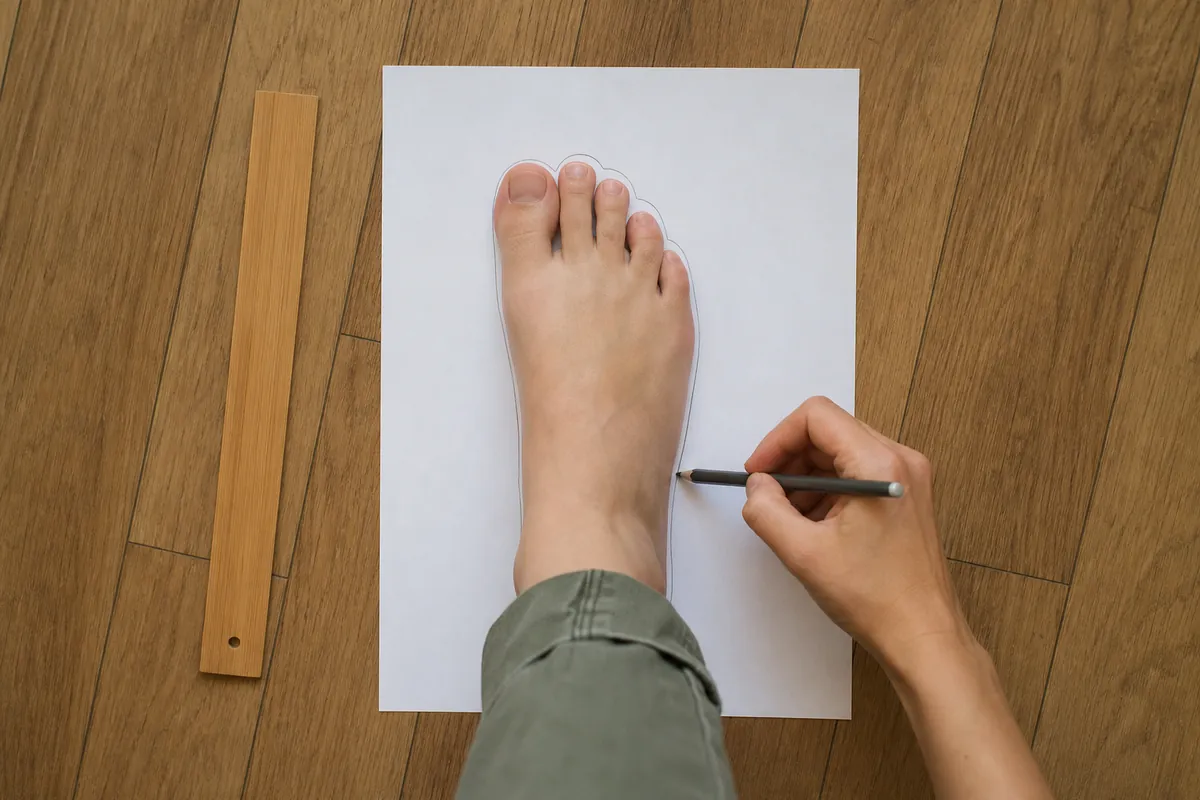
Instead of converting labels, convert your foot. Measure your foot in centimeters (see how to measure your feet), and match it to the chart for that brand. Our data lists foot lengths for each size, and the brand charts do not agree on exactly where the men's and women's rows line up. For example, on the Nike-style chart a men's 9 is listed at 27 cm, while a women's 10.5 is listed at 27.5 cm. The label rule and the foot-length columns can be half a size apart, which is the main reason to keep your size choices flexible.
If you want to skip the arithmetic entirely, the shoe size calculator takes a foot length and returns the size for each brand.
When the rule breaks
The +1.5 and +1 rules are averages. They break down in three common situations.
- Very small and very large sizes. Charts thin out at the ends. Our Nike-style men's chart starts at 6, so a women's 6 has no direct men's match, and a men's 14 has no women's row beyond 12. At these edges, use foot length.
- Brand-specific models. A model built on a narrow women's last can fit a half size smaller than the rule predicts. Some collaborations are released in men's sizing only, with a separate women's version cut differently.
- Mixed charts. A retailer may list US men's, US women's, UK and EU in one drop-down, and the rows may be rounded differently from the brand's own chart. If two numbers disagree, trust the one that comes from the brand.
Checking a conversion in thirty seconds
Take your usual size and write it down with its gender. Apply the rule for the brand. Then look up the UK and EU numbers for the result in our conversion chart. If the UK or EU number looks right next to a pair you already own and like, you have the correct size. If it is half a size off, check your foot length against the brand's chart and pick the size that matches it.
This takes less time than a return, and it works the same way for any brand. A pair you already own is the best reference you have: look at its tag, note the UK and EU size, and use those numbers when you shop for something new.
Unisex models
Many retro sneakers are listed in men's sizes only, with a note that women should subtract the offset. Others are listed in both. If a page shows two scales, read the heading above the size you click, because "8" can mean a men's 8 or a women's 8, and the two differ by a size and a half in length.
Buying for someone else
If you are buying a gift, ask for the size on a pair they already wear, and ask for the brand and gender label too. A women's 9 in one brand is not the same as a women's 9 in another. Where possible, get the UK or EU number as well, since those are unisex and avoid conversion mistakes altogether.
Kids' and youth sizes
Youth and grade-school sizes are a separate scale from men's and women's, and a big-kid size 6Y is not a men's 6. How youth sizes line up with women's sizes depends on the brand, so use the brand's own table when an adult with small feet is shopping in kids' ranges.
A short checklist
- Start with the brand's own size chart.
- Use +1.5 for Nike, New Balance and Asics, and +1 for Adidas.
- If the result is a half size the model does not offer, choose by foot length.
- Prefer UK or EU numbers when the product page shows them.
- Expect women's models to be narrower than men's models in the same length.
Frequently asked questions
What is a women's 8 in men's sizes?
A men's 6.5 at Nike, New Balance and Asics, where you subtract 1.5, and a men's 7 at Adidas, where you subtract 1. Check that the model is sold in that size, because many men's ranges start at 6 or higher, and expect a roomier fit than the women's version.
Are UK and EU sizes the same for men and women?
Yes, both are unisex scales, so a UK 8 or an EU 42 is the same for everyone. Brand charts do not always agree perfectly, and at some sizes the men's and women's rows differ by half a UK size or half an EU point, so confirm with the brand's own chart.
Why is the Adidas conversion different?
Adidas builds its sizing on a UK scale and uses a gap of 1 between men's and women's US sizes, rather than 1.5. A men's 9 is therefore a women's 10 at Adidas, but a women's 10.5 at Nike. Always check which brand's rule you are using.
Will a men's shoe fit me if I convert my women's size?
Usually in length, but not always in shape. Men's shoes are generally wider through the forefoot and heel, which suits many wide-footed buyers and loosens the fit for narrow feet. Try the converted size and check heel hold and toe room.
Is there a better method than converting sizes?
Yes. Measure your foot length in centimeters and match it to the brand's chart. This avoids the half-size differences that show up between brand rules and chart rows. A shoe size calculator or a brand comparison chart can do the match for you.