Chinese Shoe Size to US: Conversion Chart for Men and Women
Chinese 250 means a 25.0 cm foot. Our chart converts mm and CN numbers to US men's and women's sizes, and shows why marketplace charts disagree.
Quick answer
A three-digit Chinese size is the foot length in millimeters: 250 means 25.0 cm, about a men's US 7.5 or women's US 9. The older two-digit CN number is roughly 2 x foot cm minus 10, close to EU. Marketplace charts differ by seller, so trust the foot length in mm.
The reliable way to convert a Chinese shoe size to US is to use the millimeter number. A Chinese label of 250 means a foot length of 25.0 cm, which is about a men's US 7.5 or a women's US 9. The older two-digit Chinese numbers, such as 40 or 42, are looser: they land near the EU size but depend on who printed them.
If you are buying from AliExpress, Temu, Shein or Taobao, that distinction decides whether the shoes fit. The tables below are built from foot length, so you can match your own measurement instead of trusting a label. We also explain why two sellers can print different numbers for the same shoe.
Two systems hiding behind one label
Chinese listings use two kinds of numbers, and they look nothing alike once you know what to look for.
- Millimeter sizes (three digits). Numbers like 235, 250 or 275. This is the foot length in millimeters, the same idea as Mondopoint. Women's charts typically run from about 220 to 265, and men's from about 245 to 335. Chinese national standard GB/T 43293-2022 covers footwear sizing, though not every seller follows it.
- Two-digit sizes (35 to 45 for women, 39 to 51 for men). These look like EU sizes and mostly behave like them. They are not an official foot-length measurement, and on marketplaces they may be nothing more than the seller's chosen label.
Never assume that "CN 40" equals "EU 40" for the shoe in front of you. It is often close, but close is not the same as identical, and the difference can be half a size.
The conversion rule for the millimeter label
For the millimeter system, divide by ten to get centimeters, then look up the foot length on a US chart. The rule on this site is that the mm label equals the foot length in millimeters, rounded to the nearest 5 mm. The reverse works too: measure your foot, round to the nearest 5 mm and you have the number to look for.
The older Chinese number follows a formula: CN equals twice the foot length in centimeters minus 10. A 26.2 cm foot gives 42.4, so you would see a 42 on the label. That lands close to the EU number, which is why the two get confused. The tables below show the result for each size, rounded to the nearest half.
Men's chart
This table uses our standard men's rows. The millimeter column is the foot length rounded to the nearest 5 mm, so it will sit a little below the CM (JP) label you see on a sneaker box. That label includes toe room, so it is not a foot length.
| US men's | Foot length (cm) | Mondopoint (mm) | Old CN number (approx.) | EU |
|---|---|---|---|---|
| 6 | 23.7 | 235 | 37.5 | 38.5 |
| 6.5 | 24.1 | 240 | 38 | 39 |
| 7 | 24.6 | 245 | 39 | 40 |
| 7.5 | 24.9 | 250 | 40 | 40.5 |
| 8 | 25.4 | 255 | 41 | 41 |
| 8.5 | 25.9 | 260 | 42 | 42 |
| 9 | 26.2 | 260 | 42.5 | 42.5 |
| 9.5 | 26.7 | 265 | 43.5 | 43 |
| 10 | 27.1 | 270 | 44 | 44 |
| 10.5 | 27.5 | 275 | 45 | 44.5 |
| 11 | 27.9 | 280 | 46 | 45 |
| 11.5 | 28.4 | 285 | 47 | 45.5 |
| 12 | 28.7 | 285 | 47.5 | 46 |
| 12.5 | 29.2 | 290 | 48.5 | 47 |
| 13 | 29.7 | 295 | 49.5 | 47.5 |
| 14 | 30.5 | 305 | 51 | 48.5 |
| 15 | 31.3 | 315 | 52.5 | 49.5 |
Example: a 27.1 cm foot is a men's US 10, an EU 44 and a Chinese 270 in the millimeter system. The older CN formula gives about 44.
Women's chart
Women's rows work the same way. Keep in mind that the US women's scale runs 1.5 numbers above the men's scale for the same foot, so a Chinese 240 is a women's US 8 and a men's US 6.5. Always confirm which scale a converter is using before you read the number.
| US women's | Foot length (cm) | Mondopoint (mm) | Old CN number (approx.) | EU |
|---|---|---|---|---|
| 5 | 21.6 | 215 | 33 | 35.5 |
| 5.5 | 22.0 | 220 | 34 | 36 |
| 6 | 22.4 | 225 | 35 | 36.5 |
| 6.5 | 22.9 | 230 | 36 | 37.5 |
| 7 | 23.3 | 235 | 36.5 | 38 |
| 7.5 | 23.7 | 235 | 37.5 | 38.5 |
| 8 | 24.1 | 240 | 38 | 39 |
| 8.5 | 24.6 | 245 | 39 | 40 |
| 9 | 24.9 | 250 | 40 | 40.5 |
| 9.5 | 25.4 | 255 | 41 | 41 |
| 10 | 25.9 | 260 | 42 | 42 |
| 10.5 | 26.2 | 260 | 42.5 | 42.5 |
| 11 | 26.7 | 265 | 43.5 | 43 |
| 12 | 27.5 | 275 | 45 | 44.5 |
Fit tip: Read the row in your own foot-length column, then check the listing. If the seller shows a recommended foot length for each size, that number beats any conversion table, including ours.
Why marketplace charts disagree
Here is the honest picture. The conversion guides we checked give approximate ranges, not exact answers. One of them lists CN 39 as roughly a women's US 8 to 8.5 and CN 40 as roughly US 8.5 to 9, while the same CN 39 in men's sizing comes out near a men's US 6 to 6.5. Those spreads are real, and they exist because:
- Sellers write their own charts. The same size label on two listings, even on the same platform, can describe different shoes.
- The label may not match the stated foot length. One men's chart we saw lists a 245 label against 24.2 cm of foot rather than 24.5, so the number on the box is not always the foot it fits.
- Half sizes are not always labeled. Some Chinese sizes jump in steps that do not carry a .5, so two neighboring labels can be about half a US size apart.
- Last shape matters. A millimeter label tells you about length, not about toe room or volume. Two shoes of the same length can feel very different.
How to order from a marketplace without guessing
Follow this order of operations and you will avoid most returns.
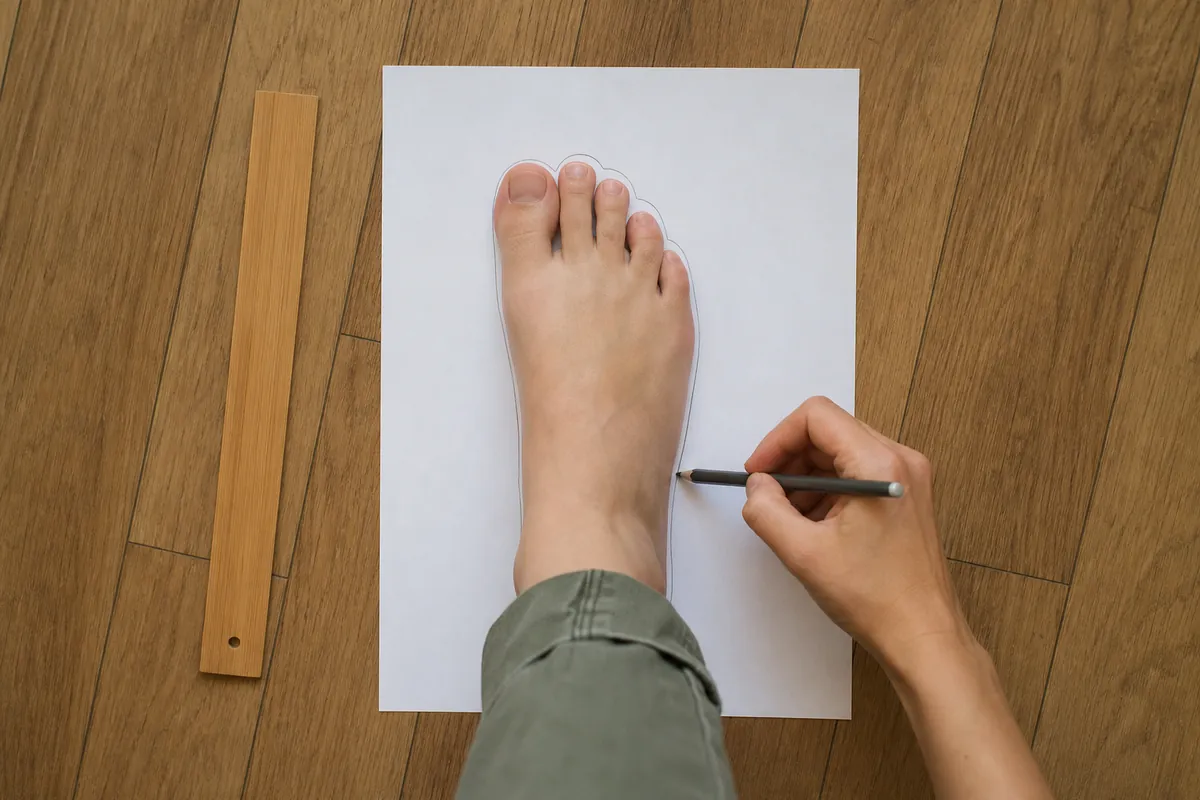
- Measure your longer foot in centimeters while standing, preferably in the evening. Our guide to measuring your feet covers the method.
- Open the size chart for that listing, not the general platform chart. Find any column labeled foot length, heel-to-toe or insole length.
- Match your foot length to the nearest row. If the chart gives a recommended foot length, pick the row that equals or slightly exceeds your measurement.
- Check the customer photos or reviews for fit comments on that specific shoe. Reviewers who say a model runs small are usually right.
- Check the return policy before paying. Cross-border returns can cost more than the shoes.
The conversion guide we consulted advises measuring without adding extra length for toes, unless the maker says so. We would not follow that for running or walking shoes. In general, you want some free space ahead of the longest toe, roughly a thumb's width in athletic shoes, so a listing that lists a foot length equal to your own is a tight fit for those.
Insole length versus foot length
Some Chinese charts list insole length in addition to foot length. The insole is longer than the foot it is made for, because toe room is built in. If a chart shows a column that is clearly larger than the foot column, it is a shoe measurement. Compare your foot to the foot column and use the insole column only to check whether the shoe will leave enough space.
When a seller gives only an insole length, compare it to your foot length and look for roughly a thumb's width of extra room ahead of your longest toe. That is a common rule of thumb, not a standard, so use it as a sanity check rather than a promise.
Kids' sizes from Chinese sellers
Kids' charts from China usually run in millimeters, starting as low as 70 for tiny infant shoes and going up to about 250. They map to US toddler (C) and youth (Y) sizes, and one chart we saw maps a single Chinese size to two US sizes, for example 235 to either 4.5Y or 5Y. That overlap is a sign that the conversion is approximate. For children, measure the longer foot, choose a size with growing room, and check the seller's own chart. Do not apply the adult tables here.
Brands from China in Western sizing
Many sneaker and running brands made in China sell internationally with their own size tables, and these tend to be reliable because the brand maintains them. If you are shopping a well-known label, use its own chart and ignore the generic conversion. For major brands we cover, see the brand size comparison for how the same foot reads on each label.
Quick conversions you can sanity-check
- A 24.1 cm foot: Chinese 240, men's US 6.5, women's US 8, EU 39.
- A 25.4 cm foot: Chinese 255, men's US 8, women's US 9.5, EU 41.
- A 26.2 cm foot: Chinese 260, men's US 9, women's US 10.5, EU 42.5.
- A 27.1 cm foot: Chinese 270, men's US 10, EU 44.
These come straight from the standard rows above. If a seller's chart disagrees by more than half a US size, treat that chart as unreliable for that listing and ask them, or choose a seller who publishes a foot length.
Between two sizes
Because mm labels move in 5 mm steps, you will often fall between two rows, for example a 25.7 cm foot sitting between a 255 and a 260. For sneakers, running shoes and anything you will walk in for hours, take the longer label. For a leather or fabric shoe with a soft upper that you expect to give a little, the shorter one can work if the shoe is not tight across the toes. If the shoe is cheap and glued, assume it will not stretch much, and take the longer size.
What to do if the shoes arrive wrong
If the shoes are too short, the fix is usually a larger size, not stretching. Stretching adds width easily but length barely at all, and our guide on how to stretch shoes explains the limits. If the shoes are only tight across the forefoot, a wide-fit or less tapered model is a better answer than a longer size. Keep your measurements and the seller's chart as screenshots, because they make a return request much easier.
Bottom line
Use the millimeter number as your anchor: it is your foot length in mm, rounded to 5. Convert it with the tables above, and treat the older two-digit Chinese numbers as an EU-like approximation. Marketplace charts differ by seller, so the foot length in the seller's own chart is the figure to trust. For the other conversions, the shoe size conversion chart and the shoe size calculator take the same foot length and return US, UK and EU sizes.
Frequently asked questions
What does a Chinese shoe size of 250 mean?
It means a foot length of 250 millimeters, or 25.0 cm. On a US chart that is about a men's US 7.5 or a women's US 9. It describes the foot, not the toe room inside the shoe.
Is Chinese size 40 the same as EU 40?
Not automatically. The two-digit CN number usually lands near the EU size and follows roughly 2 x foot length in cm minus 10, but some sellers choose labels freely. Check the foot length in the listing's own chart.
Why do AliExpress and Temu sizes run small?
Charts are written by each seller, and the same label can describe different shoes. Many buyers report small fits, but we cannot give a rate. Compare your foot length to the seller's chart and read reviews for that item.
How do I convert a Chinese millimeter size to US?
Divide by 10 to get centimeters, then find that foot length on a US chart. 260 is 26.0 cm, near a men's US 9 or a women's US 10.5. If you are between rows, take the larger size for athletic shoes.
Can I use adult Chinese charts for kids?
No. Kids' charts start much lower in millimeters and map to US C and Y sizes, and some Chinese sizes map to two US sizes. Use the seller's kids' chart and measure the longer foot.