Birkenstock Sizing: EU Size Chart, Regular vs Narrow Width
Birkenstocks run true to size in EU numbers. Here is how to convert from US, pick regular or narrow, and size sandals and clogs.
Quick answer
Birkenstocks are sized in EU numbers and generally run true to size. A men's US 9 is about EU 42 and a women's US 7 about EU 38. Choose regular width unless your feet are slim, and take the larger size if you fall between two.
- Fit
- True to size
- Width
- Varies
- Our advice
- Order your EU size; take the larger if between sizes; narrow only for slim feet.
Birkenstocks are sold in European sizes, and in general they run true to size. Order the EU number that matches your foot, choose the regular width unless your feet are slim, and if you are between sizes take the larger one. For most Americans that means a men's US 9 lands around EU 42 and a women's US 7 around EU 38, though the half sizes need care.
Sandals are the main event here, so this guide focuses on the open styles: Arizona, Gizeh, Boston clogs and the rest. The sizing logic is the same across them, but the footbed, strap and width labels change what "right" feels like.
The EU number is the one that counts
Birkenstock prints European sizes on the footbed and the box. US numbers appear on retail listings but they are a translation. The usual rule of thumb is to add 33 to a US men's size and 31 to a US women's size, which gives EU 42 for a men's 9 and EU 38 for a women's 7. Our standard chart is a close cousin: it puts a men's US 9 at EU 42.5 and a women's US 7 at EU 38.
The half-size problem comes from the mismatch. Birkenstock makes whole EU sizes in most styles, while US sizes come in halves, so a women's US 6 and 6.5 often share the same EU number. If you are on a half size, use your foot length and the next rule below, not the rounding.
| US men's | UK | EU | Foot length (cm) | CM (JP) |
|---|---|---|---|---|
| 7 | 6 | 40 | 24.6 | 25 |
| 8 | 7 | 41 | 25.4 | 26 |
| 8.5 | 7.5 | 42 | 25.9 | 26.5 |
| 9 | 8 | 42.5 | 26.2 | 27 |
| 9.5 | 8.5 | 43 | 26.7 | 27.5 |
| 10 | 9 | 44 | 27.1 | 28 |
| 10.5 | 9.5 | 44.5 | 27.5 | 28.5 |
| 11 | 10 | 45 | 27.9 | 29 |
| 12 | 11 | 46 | 28.7 | 30 |
| 13 | 12 | 47.5 | 29.7 | 31 |
| US women's | UK | EU | Foot length (cm) | CM (JP) |
|---|---|---|---|---|
| 5 | 2.5 | 35.5 | 21.6 | 22 |
| 6 | 3.5 | 36.5 | 22.4 | 23 |
| 6.5 | 4 | 37.5 | 22.9 | 23.5 |
| 7 | 4.5 | 38 | 23.3 | 24 |
| 7.5 | 5 | 38.5 | 23.7 | 24.5 |
| 8 | 5.5 | 39 | 24.1 | 25 |
| 9 | 6.5 | 40.5 | 24.9 | 26 |
| 10 | 7.5 | 42 | 25.9 | 27 |
Use these rows as an anchor, not as Birkenstock's own chart. The brand publishes its own size table and foot-length guide, and that should win whenever the two differ.
Regular or narrow
Most Birkenstock models come in two footbed widths. Regular is the default and suits average to wide feet. Narrow is cut for slim feet. Retail listings often explain the labels in US width letters: for women, regular is roughly C to D and narrow roughly A to B. For men, regular is roughly D to EE and narrow roughly B to C. See our shoe width chart for how those letters compare.
On the footbed itself, an empty foot outline usually marks regular width, while a filled outline marks narrow. That small symbol saves a lot of confusion when you buy second-hand.
Fit tip: If your foot hangs over the cork edge on the sides in regular, you do not need a bigger size. You need the wide-cut model or a different style. A narrower foot that slides around on the footbed should try the narrow cut, not a smaller number.
How a good fit looks
Stand on the sandal with your weight on it. Your heel should rest in the deep heel cup, with the back of your heel on the cork and not hanging off. Your toes should end just short of the front edge, with about a thumb's width in the closed-toe styles, and a little less in the open sandals so the toes do not slide off. The widest part of your foot should sit over the widest part of the footbed.
The footbed should not extend more than a few millimeters past your foot at the sides. Skin spilling over the edge usually means the width is too narrow. A visible gap all around means the sandal is too large or too wide.
Arizona, Gizeh and other open styles
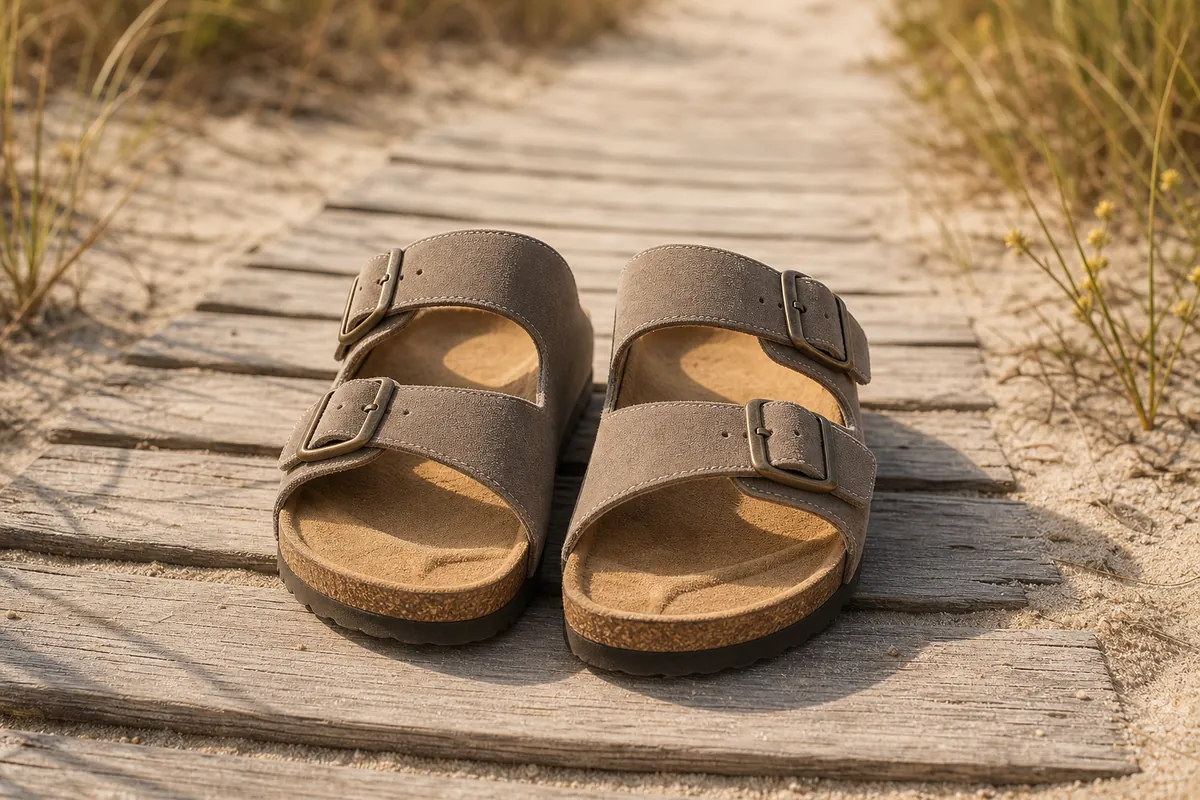
For the two-strap Arizona, strap adjustment does most of the work after you have the length right. The buckle lets you loosen or tighten the forefoot strap, so a slightly high instep rarely needs a bigger size. For the thong Gizeh, the strap between the toes is fixed, so length matters more, and a size that is too short makes the toes grip. Many wearers who like a softer feel pick the soft footbed, which some people find a touch narrower than the classic cork version.
Unisex-labelled styles are often reported to run wider than the women's-specific ones. If a unisex sandal feels loose, that may be a shape difference and not a size error.
Closed shoes and clogs
Closed styles such as the Boston clog or a slip-on leather shoe have a toe box, so they care about volume as well as length. Go by the same EU number as in a sandal, but think about socks. Wearing the Boston with thick wool socks usually calls for a roomier fit, and the clog may need half a size more than a sandal. Because Birkenstock mostly uses whole EU sizes, check the brand's chart for each style and see whether the closed style is built on a different last.
Break-in
Birkenstocks are not a shoe you wear all day on the first day. The cork-latex footbed gradually molds to your foot, and the leather straps soften. Start with short sessions for the first week or so. Flex the footbed gently and open the straps before wearing, then adjust them snug but not tight.
Some pairs are comfortable from the start and need little of this. If the sandal pinches or rubs at the very first fitting, however, that is a sizing or width issue, not something break-in will solve.
Fit tip: Break-in softens leather and shapes the cork, but it does not add length. If your toes are at the front edge of the footbed on day one, go up a size.
Men's and women's sizes
Birkenstock lists sizes in EU numbers for everyone. The US men's and women's numbers differ by about 2, so a man in EU 42 and a woman in EU 42 are wearing the same footbed length, even though the labels read men's 9 and women's 11. If you are buying a unisex style, find the EU number first, then translate. Our men's to women's guide explains the offset in general terms.
If you are between sizes
- Between two EU sizes in an open sandal: take the larger, since a sandal that is too short leaves your heel off the cup or your toes over the edge.
- Between regular and narrow: take regular if the foot is at all wide, and narrow only if there is clear side-to-side movement.
- Wearing socks with sandals: take the larger size, and consider the closed styles.
- Wide feet and high arches: try the regular width first and see our wide feet guide.
How to measure for Birkenstocks
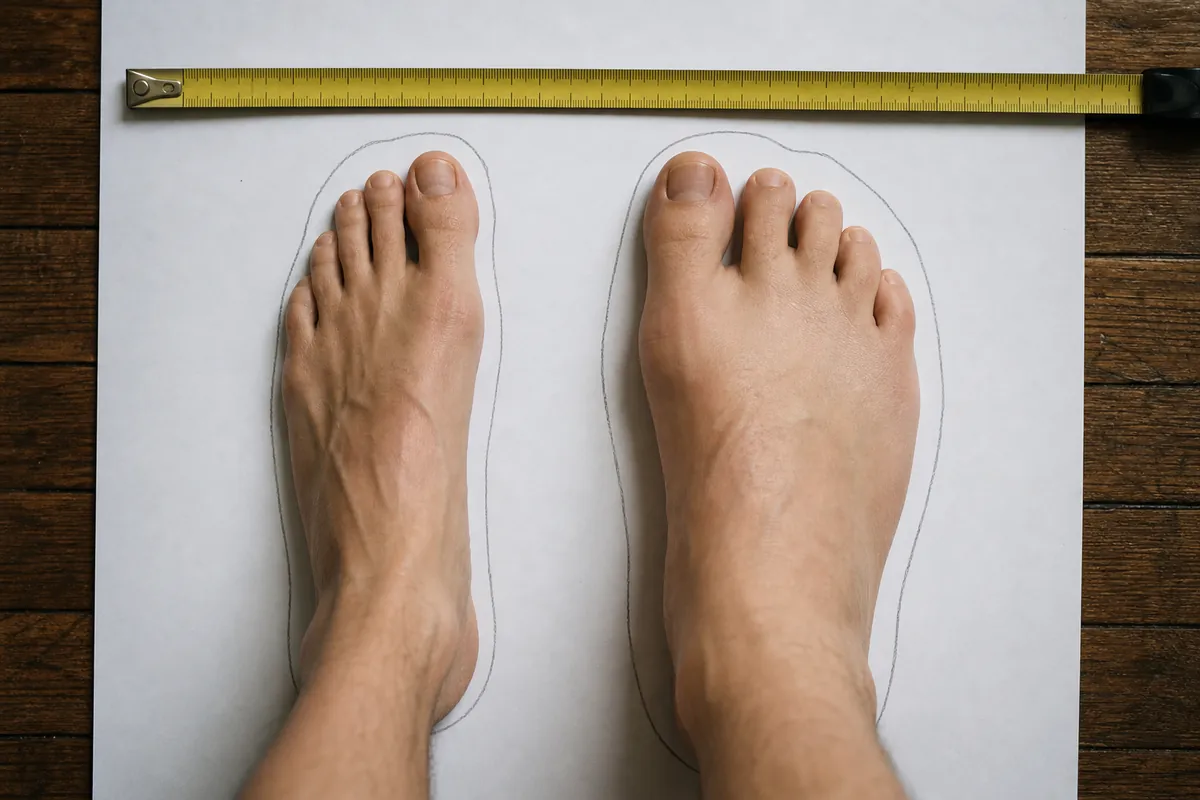
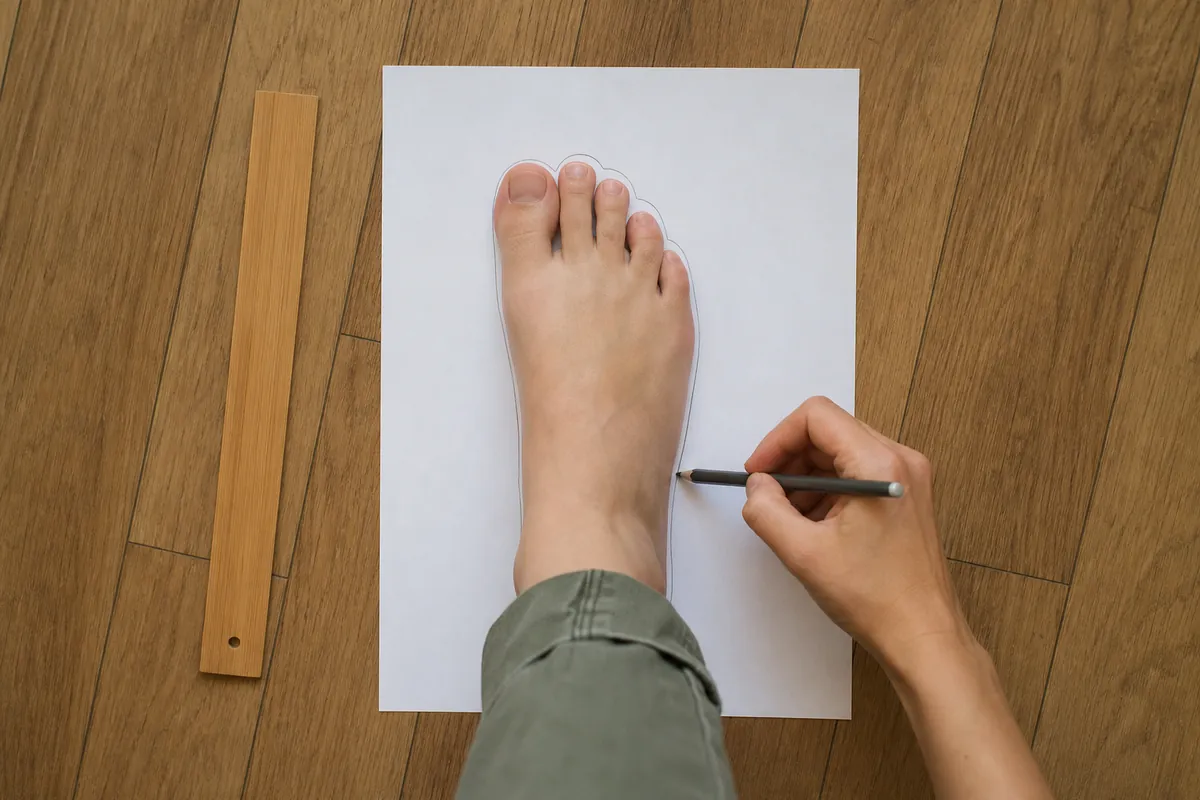
Measure your longer foot in millimeters or centimeters, using the method in our foot measuring guide, and do it in the evening. Compare your measurement with Birkenstock's own foot-length table, and not with the footbed of an old pair, since the footbed gets slightly longer and wider as it molds and wears. If you are between sizes after that, take the larger one.
A men's US 9 corresponds to a 26.2 cm foot on our chart, and a women's US 7 to 23.3 cm. Those lengths are useful anchors, but the brand's chart decides which EU number covers them.
Materials change the feel
Leather, suede, Birko-Flor and EVA all fit a little differently. Smooth leather straps soften and stretch slightly over the first weeks. Suede is gentler on the skin from day one. Birko-Flor, a synthetic upper, tends to stay as it is, so choose the buckle position carefully on day one. The molded EVA models such as the Arizona EVA are one piece of foam with no cork to mold, so what you feel in the store is what you will get.
The cork footbed itself darkens and compresses where your heel and toes press, which is normal and part of why a well-worn pair feels custom. A new pair will feel firm and slightly higher in the arch than an old one. Do not read that firmness as a wrong size.
Common sizing mistakes
- Using your sneaker size without converting. A US sneaker size does not carry across as a number. Convert through the EU size or, better, your foot length.
- Buying narrow to fix a loose strap. Straps handle volume. Narrow handles the side-to-side width of the footbed, so only choose it if your foot is slim.
- Judging the fit by the toes alone. The heel cup and the arch contact matter as much. If the arch bump hits the wrong spot, the style or size is wrong, and a different pair may help.
- Ordering the wrong gender scale. The US men's and women's labels differ by about 2 sizes in Birkenstock's own system, so make sure the EU number is the thing you are matching.
Kids and growing feet
Children's Birkenstocks are sold in EU sizes as well, and children's feet grow quickly, so it is tempting to buy a large size. A sandal that is too long makes a child trip, and one that is too short pinches. A thumb's width of room at the front is a sensible target for a growing child, and the footbed should be checked every few months. Do not hand down a footbed that has already molded to a sibling's foot if you want the cork to shape to the new wearer.
Used and resold pairs
Pre-owned Birkenstocks are common, and the molded footbed is both their selling point and their problem. A pair that has taken the shape of someone else's foot will rarely suit yours perfectly, even if the EU size and width match. If you buy a used pair, ask for photos of the footbed and the sole, and check the width symbol. A fresh pair is a safer buy if you care about the footbed shape.
Bottom line
Use the EU size, pick regular width unless your feet are clearly slim, and go up if you are between sizes. Use our US to EU guide for the arithmetic and our shoe size calculator for a quick check against your measurement.
Frequently asked questions
What size Birkenstock is a US men's 9?
Around EU 42. A common rule adds 33 to the US men's size, while our standard chart shows EU 42.5. Birkenstock mostly sells whole EU sizes, so check the brand's own foot-length table, and take the larger if you are between sizes.
What is the difference between regular and narrow Birkenstocks?
Regular footbeds suit average to wide feet, and narrow footbeds suit slim feet. On the footbed, an empty foot outline marks regular and a filled outline marks narrow. The sizes in length are the same.
Do Birkenstocks run big or small?
In general they run true to size, though some styles, especially unisex ones, can feel wider. If a pair feels loose, check the width before changing the size.
Should I size up in Birkenstock clogs or with socks?
If you plan to wear thick socks, many wearers choose the larger size in closed styles, since toe box volume matters there. In open sandals, size by foot length and adjust the straps.
How long does it take to break in Birkenstocks?
A common approach is in short sessions for the first week or so while the cork footbed molds. Break-in softens the shoe but does not add length, so a sandal that is too short stays too short.