R.M. Williams Sizing: UK Sizes, G/F/H Widths and Craftsman Fit
Convert your Brannock to UK (minus one), pick the right G, F or H width, and know how the slim Craftsman last behaves.
Quick answer
R.M. Williams boots are true to size in length if you use UK sizing: subtract one from your US Brannock size, so a US 9 is a UK 8. The lasts are slim, so if the ball of your foot feels squeezed, go up a width letter (G to H) rather than a full size.
- Fit
- True to size
- Width
- Narrow
- Our advice
- Subtract one from your Brannock for UK sizing; step up G to H if you are broad.
R.M. Williams boots fit true to size in length when you start from a real Brannock measurement, and they are slim in width. Convert your Brannock size to UK by subtracting one (a US 9 becomes a UK 8), choose the fitting letter that matches your width, and expect a snug fit with a little heel slip at first.
The trap is not the length. It is the label on the box. R.M. Williams uses UK/Australian numbers plus a letter (G, H and so on), and a lot of buyers either forget the one-size shift or pick the wrong letter and end up with pinched little toes. This guide walks through how to read the system and how to choose between neighboring sizes.
Read the label first: number and letter
A boot marked 8G is a UK/Australian 8 in a G fitting. Men's sizes run from 1 to 18, women's from 5 to 11, and half sizes exist in the charts. The number is length. The letter is width.
Men's fittings are F (narrow), G (regular), H (wide) and X (extra wide). Women's are D (regular) and E (wide). Each step up adds roughly a quarter inch (about 0.64 cm) of room across the same length, which is a lot more width than a half size gives you.
Here is the part that trips people up: the letters are not US letters. Sources commonly line G up with a US D and H with a US E, but the boots are cut on slim lasts, so a G can feel narrower than the D you wear in an American boot. Treat that equivalence as a starting point, not a promise.
Converting from your Brannock size
Get measured on a Brannock device if you can. Sneaker size is a poor starting point here, because sneakers are cut generously and flex around the foot, while a pull-on leather boot has to hold your heel with elastic and leather alone. If you only know your sneaker size, treat it as a rough guess and plan to try the boot on.
From the Brannock, the conversion is simple: UK/AU = US minus 1. Here is the standard chart for reference, with the UK column showing that same shift.
| US men's | UK | EU | Foot length (cm) | CM (JP) |
|---|---|---|---|---|
| 7 | 6 | 40 | 24.6 | 25 |
| 7.5 | 6.5 | 40.5 | 24.9 | 25.5 |
| 8 | 7 | 41 | 25.4 | 26 |
| 8.5 | 7.5 | 42 | 25.9 | 26.5 |
| 9 | 8 | 42.5 | 26.2 | 27 |
| 9.5 | 8.5 | 43 | 26.7 | 27.5 |
| 10 | 9 | 44 | 27.1 | 28 |
| 10.5 | 9.5 | 44.5 | 27.5 | 28.5 |
| 11 | 10 | 45 | 27.9 | 29 |
| 11.5 | 10.5 | 45.5 | 28.4 | 29.5 |
| 12 | 11 | 46 | 28.7 | 30 |
One honest caveat. One widely read source gives the example "US 8D equals UK 7.5G" on one page and "US 8.5D equals UK 7.5G" on another. The second matches the one-size shift; the first does not. If a chart ever contradicts the minus-one rule, trust the rule and your own measurement, and ask the retailer.
Fit tip: Write down your Brannock length, your Brannock width and which foot is bigger before you shop. Size to the larger foot, and measure at the end of the day, wearing the socks you will actually wear with the boots.
Why the width letter matters more than the half size
People who buy their usual length and find the boot tight across the toes often reach for a half size up. That adds length, and a little volume, but it does not fix a narrow lasting. Going from a G to an H adds the quarter inch that the half size does not.
The rough decision rule most owners use is this:
- Heel feels held, ball of the foot feels squeezed, toe length is fine: stay at your length and go up a letter (G to H).
- Toes touch the end and the ball feels fine: go up half a size and keep the letter.
- Between two widths on a Brannock: owners commonly pick the wider fitting, since leather does not widen much on its own.
The yearling leather on the classic boots does give a little with wear, so a slightly snug boot relaxes. A boot that cramps the little toes on day one will not become a different shape, though.
Craftsman and Comfort Craftsman
The Craftsman is the boot most people picture: a sleek, narrow, slightly elongated silhouette with a chisel toe. The Comfort Craftsman is the same family with a more cushioned build. One source indicates both are built on the same last, which R.M. Williams does not publish by name; retailers and catalogs refer to it as the B543. We could not confirm exactly how the two versions differ in internal volume, so do not assume the Comfort version is wider.
What owners commonly say is that the Craftsman is a narrow boot. A man who wears a 9G may find it works better in a 9.5G, or in a 9H if his feet are broad. The giveaway of the wrong size is a squeezed pinky toe, not a heel that moves.
Other models and lasts
R.M. Williams does not print last names on its boots, so the model notes below come from retailer and community lists rather than the brand, and should be treated as guidance. If a fitter tells you something different, believe the fitter.
- Macquarie: the toe tapers from further back, so it can fit longer than a round-toe boot. One source suggests an 8G over a 7.5G where you are between.
- Gardener: described as running slightly large.
- Rickaby: true to size but leaning snug, so consider the larger neighbor, especially with thicker socks.
- Turnout: regular feet stay true to size; wider feet should go up.
- Goodwood: fuller at the ball with a rounder toe. Between two sizes, the larger of the two is suggested.
How a pull-on should feel
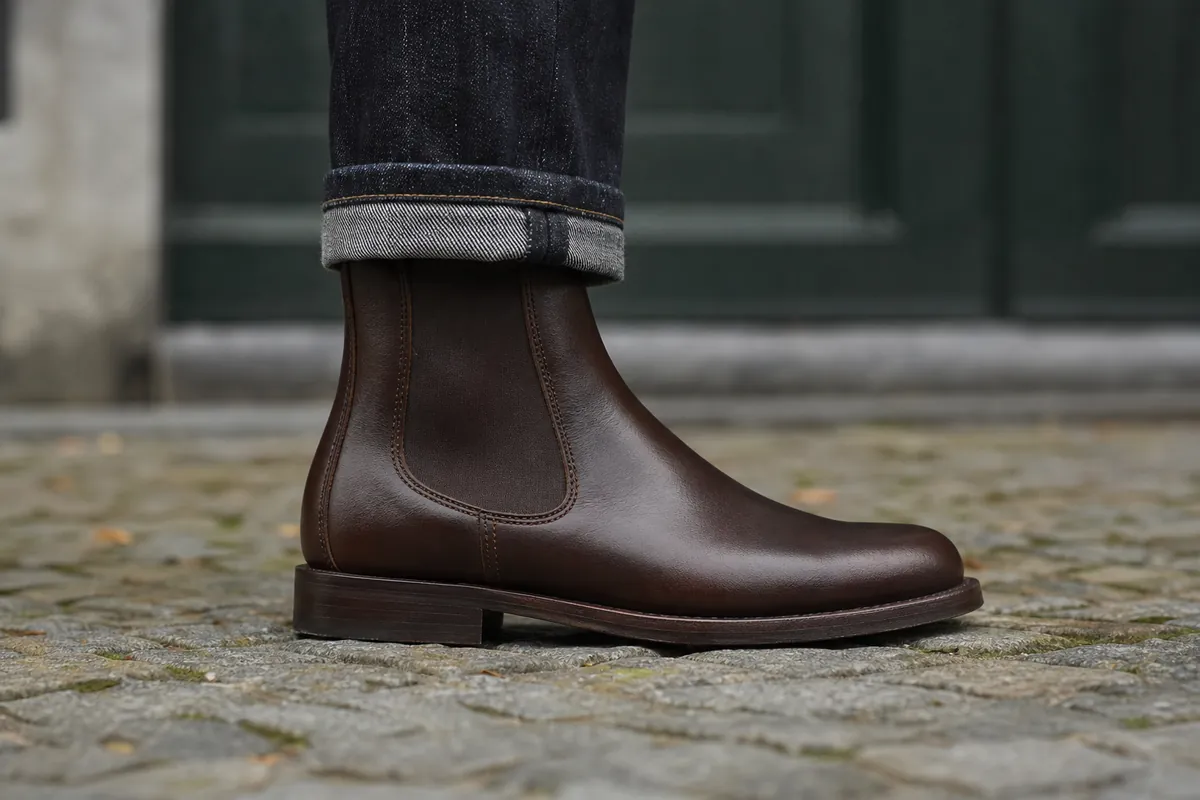
There are no laces to adjust, so the fit comes from three places: the heel cup, the instep and the elastic gussets. When you stand, the elastic should grip the ankle without biting. The instep should feel snug but not bruised.
A little heel slip when the boot is new is normal. As the leather softens and the sole flexes, it usually settles. Aim for about a thumb's width of space beyond the longest toe. If the heel lifts a lot when you walk, or the toe box is crowding you at the same time, the size or the width is off.
Fit tip: Stand up, walk to the end of the room and back, then do it again on a hard floor. A pull-on that only feels good while you are sitting is too loose or too tight in a place you have not tested yet.
How it compares with other boots you may own
R.M. Williams is not described as a "half size down from Brannock" brand, unlike many American heritage makers. If you wear a US 9 Brannock and have a Red Wing in 8.5, do not copy that half-size drop here; start from the straight conversion to UK 8. Our Red Wing sizing guide explains why that brand runs large, which is the opposite of what you should assume here.
Against a Blundstone, expect a sleeker, snugger feel from the Craftsman. A wide-footed owner who is happy in a Blundstone may need a wider letter in an R.M. Williams. Our Blundstone sizing guide covers that model. For general Chelsea-style fit principles, see how Chelsea boots should fit.
Sock thickness and time of day
Because the boot closes with elastic rather than laces, you cannot loosen it to make room. Try boots on in the afternoon, with the socks you wear most. A thick wool sock can eat the extra quarter inch that a wider letter gave you.
Feet swell through the day, and the larger foot is the one to fit. If the two feet differ, the boot should be comfortable on the bigger one; a thin insole or heel grip can handle the smaller.
Measuring at home
The brand publishes a home-measure method using paper and a tape. If you do it yourself, stand on a sheet against a wall, mark the longest toe, measure the length, then measure around the widest part of the ball. Do both feet. Our how to measure your feet guide has the full steps, and the UK to US shoe size page helps with the conversion. Check your width against the shoe width chart as well.
Three mistakes that cause most returns
- Ordering the US number. A US 9 ordered as a 9 lands you a full size too big. The UK number is one lower, and the heel will slide around like a loose slipper.
- Fixing a narrow boot with a longer one. If the ball is tight, a longer boot just moves the problem forward and adds a loose heel. Change the letter instead.
- Judging the fit sitting down. Pull-on boots feel different under body weight. Stand, flex and walk before you decide.
If you are replacing a worn pair, check the label inside the old boot before you order. Sizes and fittings can drift between older and current production, so use it as a hint rather than a rule.
Our recommendation
Measure on a Brannock, subtract one for UK, and choose your letter carefully. If you are between a G and an H, go to the H. If you are between half sizes, think about toe shape: a tapered toe may want the larger size.
When ordering online, pick a retailer with free exchanges. This is the one brand where the letter decides the outcome more than the number does, and you may need two tries to land it.
Frequently asked questions
How do I convert my US size to R.M. Williams?
Subtract one from your US Brannock size to get the UK/Australian number, so a US 9 is a UK 8. Then add the width letter: G is regular for men and roughly comparable to a US D, though it can feel narrower. Check against a retailer's chart if you are unsure.
Do R.M. Williams boots run big or small?
In length they are generally described as true to size once you use the UK number. The width is the issue: the lasts are slim, so many wearers feel snug across the ball and go up a width letter rather than a full size.
What do G, F and H mean on R.M. Williams boots?
They are men's width fittings. F is narrow, G is regular, H is wide and X is extra wide. Each step adds roughly a quarter inch of width within the same length. Women's boots use D for regular and E for wide.
Is the Comfort Craftsman sized differently from the Craftsman?
Sources we checked say both use the same last, so the sizing advice is the same. We could not confirm precisely how the cushioning changes internal volume, so try on both if you can, and expect the same slim shape.
Should I size up for thick socks?
Not usually in length, since there are no laces to loosen. If you wear thick wool socks daily, choose the next wider letter rather than a longer size, then confirm that the heel still feels held when you walk.