Viberg Boot Sizing: Brannock to Viberg Number, Lasts and Widths
Viberg numbers are UK sizes. US buyers usually take their Brannock size and go one full size down. Here is how E width and the main lasts change the fit.
Quick answer
Viberg labels boots in UK sizes. Most US buyers take their Brannock size and go one full size down, for example a Brannock 8.5 becomes a Viberg 7.5. Wearers using thick socks sometimes drop only half a size. Standard width E is slightly roomier than a US D, and the last you choose changes the fit most.
- Fit
- Runs large
- Width
- Standard width
- Our advice
- Take your Brannock size and subtract one full size for the Viberg number. Choose the last by foot shape: 2030 medium, 2020 narrow, 1035 or 2040 wide.
Viberg labels its boots in UK sizes, so a Viberg 8 is a UK 8. For American buyers the usual answer is to take your Brannock size and drop one full US size to get the Viberg number, for example a Brannock 8.5 becomes a Viberg 7.5. Some wearers who plan on thick socks drop only half a size.
The width needs as much attention as the length. Viberg's standard E is roomier than a typical US D but is not a wide fit, and the last you pick changes the feel more than any other choice.
Why the numbers look wrong at first
A Canadian maker using British numbering is the root of most confusion. On the standard men's scale, Viberg 3 corresponds to US 4, and the pattern continues up to Viberg 13 as US 14. That means a US size is always one number higher than the Viberg figure printed on the insole.
You will sometimes see claims that Vibergs "run a full size large". That is a loose way of saying the same thing: the Viberg number is lower than your US number, which looks like a size down, but the boot itself is a normal length for that UK size. If you are a UK or Commonwealth buyer you can generally order the UK size you already wear, especially on the 2030 last in E width.
Fit tip: One popular guide states both that Vibergs run a full size larger and gives worked examples with a smaller Viberg number. Ignore the wording and follow the examples: US size minus one equals the Viberg number.
Converting your size, step by step
Use the Brannock device at a shoe store, not your sneaker size, and subtract one. Our table shows how the rule plays out. These are rule-of-thumb values, not a published Viberg chart.
| Brannock (US men's) | Viberg number (full size down) | Viberg number (half size down, thick socks) |
|---|---|---|
| 7.5 | 6.5 | 7 |
| 8 | 7 | 7.5 |
| 8.5 | 7.5 | 8 |
| 9 | 8 | 8.5 |
| 9.5 | 8.5 | 9 |
| 10 | 9 | 9.5 |
| 10.5 | 9.5 | 10 |
| 11 | 10 | 10.5 |
For a boot more broadly, the gap between a Brannock and a sneaker is usually about half a size, so someone who wears 10.5 in running shoes often has a Brannock 10 and would order a Viberg 9. The shoe size calculator can help translate between systems, but always treat the Brannock number as the anchor.
What E width means at Viberg
Viberg's standard width is E. In the US system that sounds wide, but at Viberg it is simply the brand's average, a little roomier than a typical US D without being dramatically so. If you buy an E expecting a wide boot you will probably find it just about right for a medium foot.
Not every source agrees on every width. The 2030 is listed as E in some places and E minus in others, and the Halkett has been described both as an average US D and as E or EE at the front. That matters little if you try on a pair, but it is a reason to avoid treating the letters as exact.
For a quick sense of how the letters line up with other brands, see the shoe width chart.
Choosing the last
Viberg uses many lasts, and the choice changes the fit more than a half-size adjustment ever will. Each has its own personality.
| Last | Shape | Width | Who it suits |
|---|---|---|---|
| 2030 | Almond toe, medium heel and waist, slightly snug toe box | E | The standard, balanced choice |
| 2020 | Anatomical almond toe, slim heel and waist | D | Narrow feet |
| 2040 | Anatomical bump toe, raised toe box | E | Wide feet, toe splay |
| 1035 | Round, wide toe box, large heel | EE | Wide feet, high instep |
| 110 | Round toe, like the 1035 but less roomy | E | Medium to wide feet |
| 310 | Round sprung toe, high volume | EE | Rugged, roomy fit |
| 9220 and 240 | Round, high volume | EE | Hikers and bulkier models |
| 2050, 1905, 6478 | Almond variations; the 6478 has slightly more volume | Varies | Close to the 2030 with small tweaks |
Wide or splayed feet generally do better in a rounder last such as the 1035 than in the 2030, since the 2030 can feel snug across the toes.
The Service Boot and its 2014 versus 2024 change
The Service Boot is cut on the 2030 and is the model most buyers start with. It has a snug heel and a narrow waist, with arch support that is gentle rather than built up. The ball should feel comfortably snug with some toe room, and it fits similarly to Alden's Barrie and Trubalance lasts according to owners who have worn both. Our Alden sizing guide goes through those lasts.
There are two generations to know. The 2014 version had a sharper, more aggressive almond taper at the toe. The 2024 version is softer and rounder, holds its shape better and has a heel stay about a quarter inch taller. If a friend recommends a size from a pair bought years ago, check which generation they have.
The Halkett
The Halkett derby uses the 2020 last. It has a roomy forefoot but a snug heel and waist and a thin sole. Generous quarters bring the lace facings closer together, which gives a tighter instep hold than the boots. Quarter and lace-facing spacing come from the model pattern, not only the last, so two models on the same last can still fit differently over the top of the foot.
Sneaker size is a poor guide
Boots often fit a size or so smaller than sneakers, and the construction is stiffer, so extra room has nowhere to go. A running shoe forgives a sloppy fit because the upper is soft. A leather boot with a stiff counter does not.
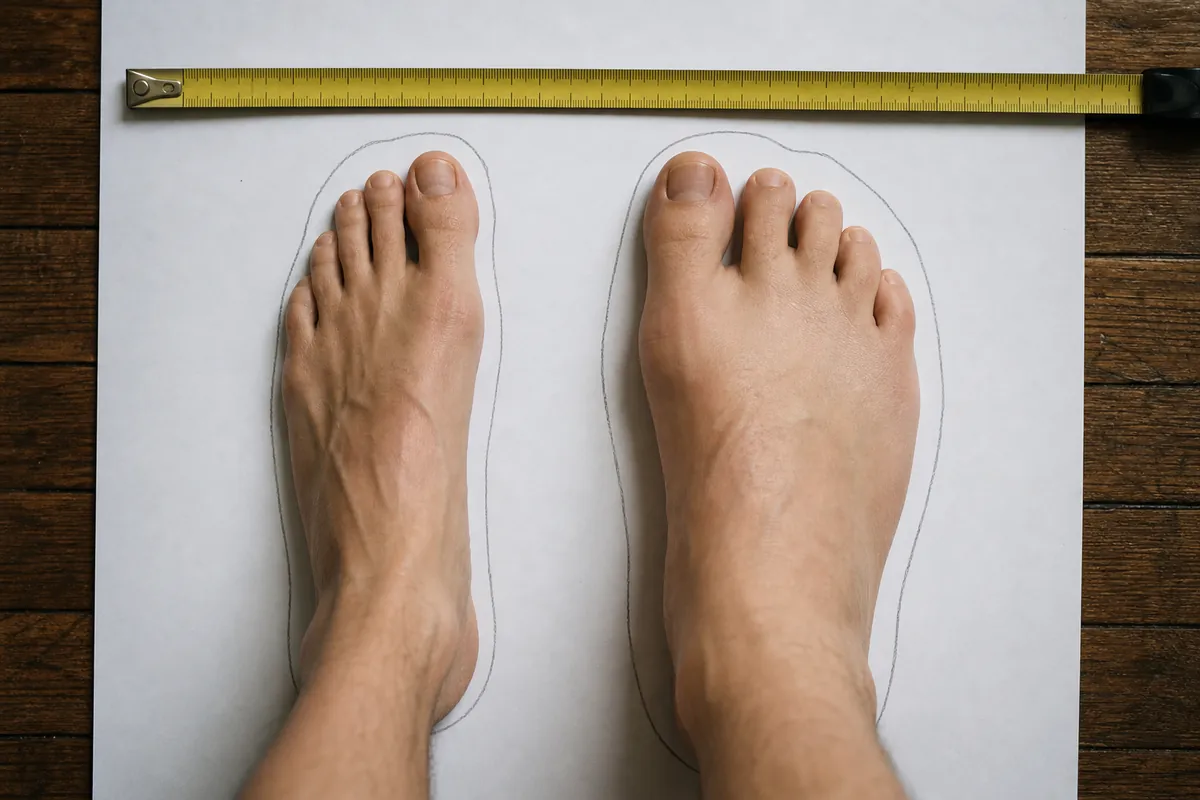
That is the reason we recommend measuring first. If you do not have a Brannock device nearby, our guide on how to measure your feet explains a home method that works well enough to narrow down the width.
Checking the fit when it arrives
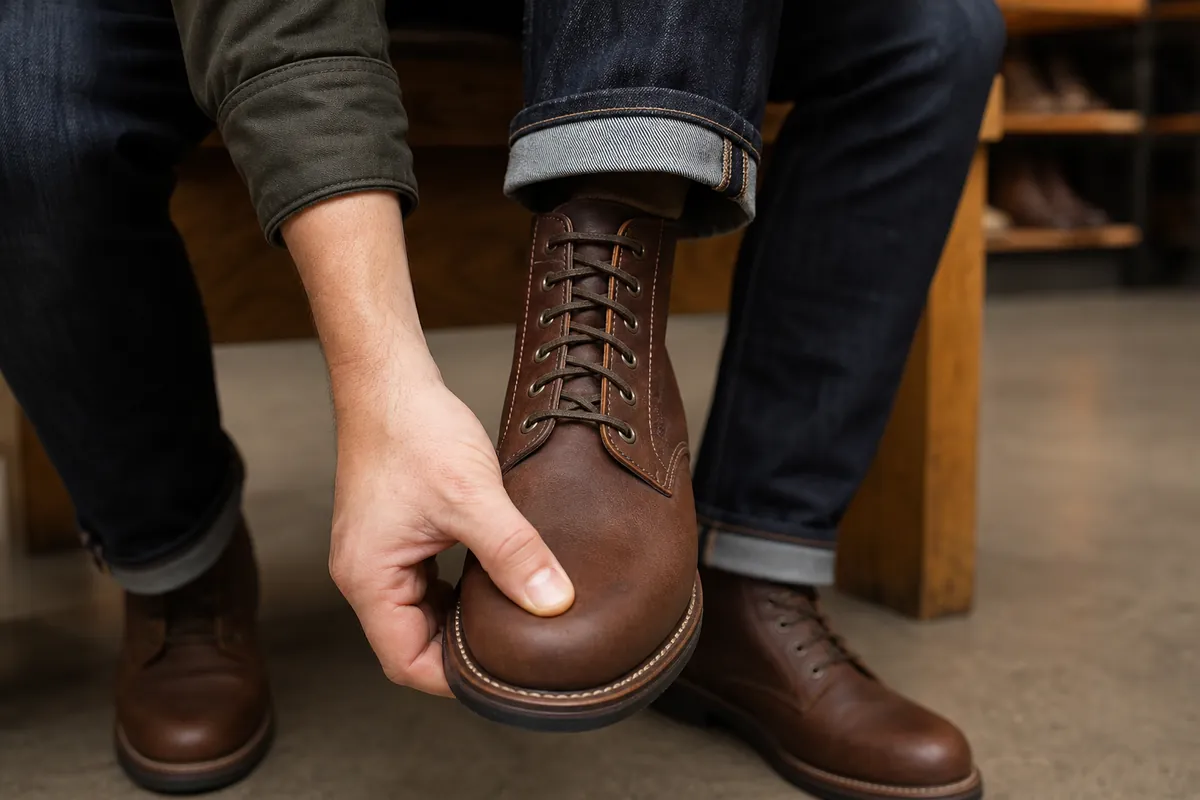
- Toe room of roughly a thumb's width at the front.
- Heel lift of no more than about a quarter inch when walking.
- A secure but not squeezed hold across the width.
- Arch length matters, because it decides where the boot flexes. A Brannock gives you this measurement along with length and width.
Wear the socks you plan to use, and bring any orthotics or insoles, because they change the volume inside the boot. For general guidance on what a correct fit feels like, see how should boots fit.
Fit tip: If you are between two Viberg numbers, think about socks and last before deciding. A thick sock and a snug last like the 2030 favor the larger number, while a thin sock and a roomy last like the 1035 favor the smaller.
Wide feet, splay and high insteps
People with a broad forefoot often get the length right and the width wrong. If your toes spread when you stand, the 2030 can feel snug even in E, and the usual fix is a different last rather than a bigger number. Going up in length to relieve a tight forefoot leaves you with a loose heel, and in a stiff leather boot the heel is the part that cannot take up the slack.
A high instep is a separate issue. A rounder, higher-volume last like the 1035 gives more clearance over the top of the foot, while a model with generous quarters, like the Halkett, pulls the lace facings closer and tightens things up. If the instep feels too loose on a given model, lacing tighter or choosing a pattern with a narrower facing gap tends to help more than dropping a size.
Pairing Viberg with other boot brands
Because the numbering is different, comparing with other brands takes one extra step. Convert your usual boot size to its Brannock equivalent first, then subtract one. A Wesco, for instance, is commonly sized half a size below Brannock, so the two brands do not use the same offset. Our Wesco guide explains that offset. One side-by-side comparison in circulation puts a Wesco 8D at about half a size shorter than a Viberg 2030 in 8.5D, though that is a single owner's observation rather than a published spec.
Common mistakes
- Ordering your US number directly. This leaves you a full size too long.
- Treating E as a wide fit and ordering a narrower last to compensate.
- Choosing the last by the look of the toe instead of the width of your foot.
- Taking the size from a pair of the 2014 Service Boot and applying it to the softer 2024 shape without trying it.
- Forgetting that both feet are measured: if one is longer, size to the larger foot.
Bottom line
For US readers, the formula is a Brannock size minus one, in the width that matches your foot. Try the 2030 first if you have a medium foot, the 2020 if you are narrow, and the 1035 or 2040 if you are wide. The numbering is the part everyone gets wrong, so write the conversion down before you order.
Frequently asked questions
What size Viberg should I get if I am a US 9?
Most US buyers take their Brannock size and go one full size down, so a Brannock 9 is a Viberg 8. Wearers who plan on thick socks sometimes drop only half a size, to 8.5. Because Viberg uses UK numbering, a US 9 corresponds to Viberg 8 on the men's chart.
Is Viberg E width wide?
No. E is Viberg's standard width, a little roomier than a typical US D but not dramatically so. For wider feet the 1035 last (EE) or the 2040 last with its raised toe box are the usual choices.
Which Viberg last is best for narrow feet?
The 2020 last is the narrow option, an anatomical almond toe in D width with a slim heel and waist. The Halkett derby is built on it and combines a roomy forefoot with a snug heel.
How did the Service Boot change between 2014 and 2024?
The 2014 version had a sharper almond taper at the toe. The 2024 version is softer and rounder, holds its shape better and has a heel stay about a quarter inch taller. Check which generation a pair is before copying someone's size.
Can I use my sneaker size for Viberg?
It is not reliable. Boots often fit a size or so smaller than sneakers, and stiff leather gives less margin for extra room. Start from a Brannock measurement instead, then subtract one for the Viberg number.