Parkhurst Boot Sizing: Last-by-Last Guide and Brannock Rules
Parkhurst boots run large: half a size down from Brannock for medium feet, a full size down for narrow ones. See each last.
Quick answer
Parkhurst boots run large. For medium-width feet, go half a size down from your Brannock size (a 9D becomes an 8.5) and a half to full size down from your sneaker size. Narrow or low-volume feet often go a full size down; E and EE feet may stay at Brannock.
- Fit
- Runs large
- Width
- Narrow
- Our advice
- Half a size down from Brannock for medium feet; a full size down for narrow or low-volume feet.
Parkhurst boots run large. If you have a medium-width, average-volume foot, plan on half a size down from your Brannock size and a half to a full size down from your sneaker size. A sneaker 10 usually becomes a Parkhurst 9.
Two exceptions matter. Narrow or low-volume feet often need a full size down from Brannock, and wider feet may stay closer to their Brannock number. The last your boot is built on decides which group you fall into.
Match yourself to a starting size
| Your foot | Typical starting size | Example |
|---|---|---|
| Brannock D, average volume | Half size down from Brannock | 9D becomes 8.5 |
| Narrow (B or C), low volume or skinny ankle | Full size down from Brannock | A 9D reading on a narrow foot: 8 |
| E or EE width | Brannock size, or half a size up for comfort | Especially with thick socks |
| Sneaker size 10 | Parkhurst 9 is common | Half to full size down for medium feet |
Pick the row that fits you, order that size, then adjust. Most buyers who end up unhappy skipped the Brannock step and worked from their sneaker label alone.
Why the last matters here
Parkhurst has used several lasts over the years, made in different factories. The factory and the lasting pressure can change how the same nominal size feels. The brand also does not offer wide lasts for most boots. Many of its combination lasts are narrow in the heel and waist and wider in the forefoot, so the boot holds your heel while giving your toes room.
| Last | Character | Size vs Brannock |
|---|---|---|
| 18 (original) | Almond toe that tapers early; snug toe box, about D width; narrow heel and waist | Snug toe box; ask Parkhurst |
| 602 | More rounded taper; forefoot up to about E | D Brannock usually means half a size down |
| 602M (Spanish factory) | About 1 to 2 mm more forefoot width and volume than the 602; snug heel and waist | Half size down |
| 608 (Upstate New York) | Narrow heel and waist, forefoot about D or E; rarely used now | Ask Parkhurst |
| 618 (Portuguese factory) | Very snug heel and waist, forefoot just over E; about 4 to 5 mm longer than the 602M | 10D Brannock is typically a 9.5; narrow feet go a full size down |
Notice the 618 detail. It is longer than the 602M, so the same half-size-down rule leaves you with a slightly longer boot. If you are between sizes on a 618, keep that extra length in mind before rounding up.
Model notes
These are reported figures, not factory specs, so use them as hints.
- Allen Horween Stitchdown (618): an 8.5D Brannock becomes an 8D.
- Allen Service Boot (602M): half size down from Brannock. Fit can vary by factory.
- Richmond (602): half size down from Brannock.
- Niagara (602M): half size down from your true size.
- Delaware (602M): half size down, unless the foot is very wide.
- Spaulding: half size down from Brannock.
Cap-toe and plain-toe versions on the same last fit the same, so you do not need to adjust between them.
Fit tip: Welted boots need extra room in front of the toes. Reports differ on how much: about an inch in one section of the source we checked and about half an inch in its FAQ. A sensible reading is that you want a clear gap, with toes that can wiggle without the foot sliding.
Comparing with other boots you own
Using a Parkhurst 8.5D as a reference, owners have compared lengths to other brands. Treat these as personal comparisons rather than official conversions.
- Wolverine 1000 Mile: nearly identical. See our Wolverine sizing guide.
- Thorogood Roofer: roughly half a size longer than Parkhurst. See Thorogood sizing.
- Alden Indy: roughly half a size longer. If your Aldens feel snug, going up half a size in Parkhurst may fit. Our Alden guide covers that brand.
- Alden Barrie-last derby: similar. Barrie-last Bluchers run longer, and calfskin barely stretches.
- Truman 79 and C55: about half a size larger than Parkhurst. See Truman sizing.
- Viberg 2020 and 2030: half to a full size longer.
- Mark Albert in 8.5EE: similar length but wider in the forefoot.
- Alfred Sargent in 9D: slightly longer.
- Sanders Bruno in EU 42: nearly identical length.
- Grant Stone Leo: longer, with more toe room.
- Grant Stone Chelsea on a Euro last: the same size may fit, but the feel differs.
The pattern is that most of the well-known names are half a size longer than a Parkhurst for the same label. So if you know your size in one of them, you may step down by half a size, but only after you check width.
What to do if your feet are not average
Narrow or low volume
Go a full size down from Brannock and check that the heel stays put. The narrow heel and waist on the combination lasts help, but a very slim ankle may still lift. Thin socks and a firm lacing pattern help.
Wider feet
Parkhurst does not offer wide lasts for most boots, so the options are a longer size or one of the wider-forefoot lasts such as the 618, which runs just over an E in the forefoot. If sharp or pinching sides show up, going up half a size is the usual fix. Our shoe width chart helps you identify where you sit.
Unusual shapes
The founder, Andrew, is known to suggest alternate sizes or lasts for unusual foot shapes. That is worth a short email if your feet do not fit a normal pattern.
Leather decides how much it stretches
Do not expect every leather to ease the same way. Chromexcel stretches. Shell cordovan, roughout and calfskin barely stretch. So if you are in doubt with a barely-stretching leather, err on the side of room, because the boot will not add it later. If you are in doubt with chromexcel, the snugger option can work, as the leather gives.
How to measure and test the fit
- Stand up straight.
- Measure length from heel to longest toe on both feet.
- Measure around the widest part of each foot.
- Check arch height and instep height.
- Compare the results to Parkhurst's size chart.
- Try boots on later in the day, when feet are most swollen.
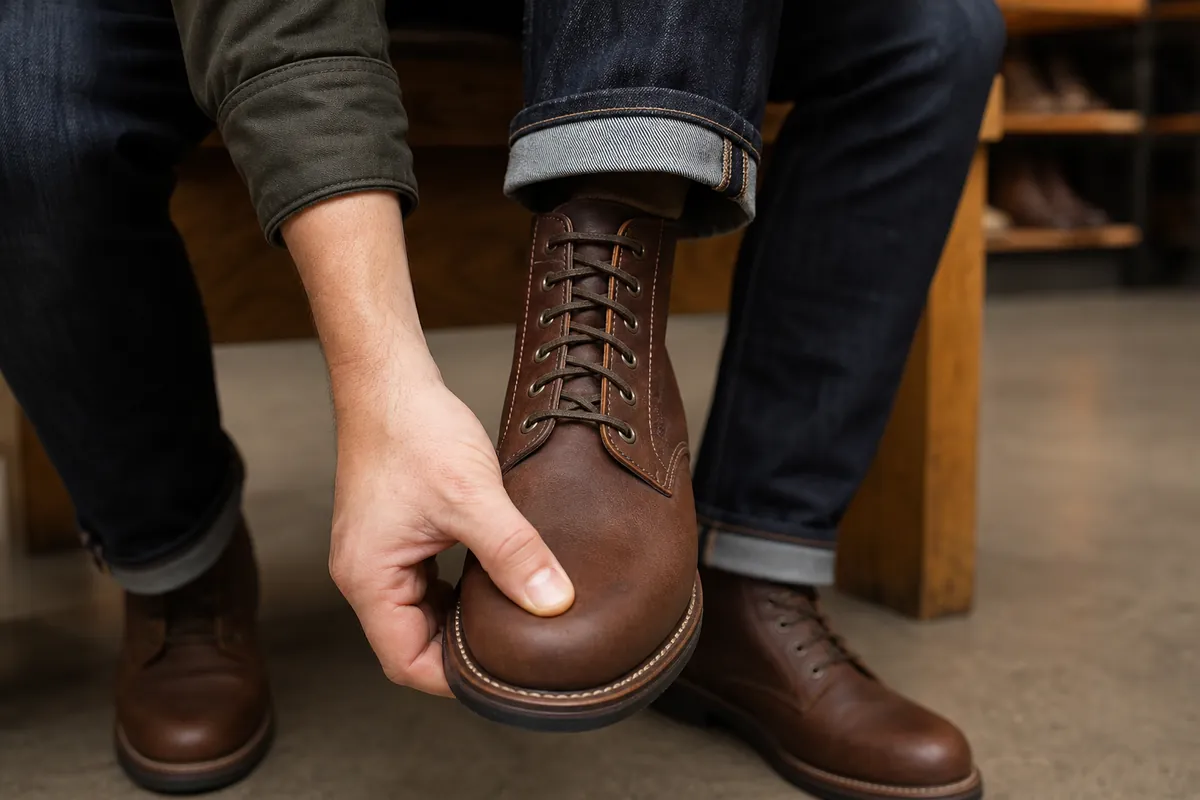
Our how to measure your feet page covers the technique in more detail. Once the boots are on, you should be able to wiggle your toes without your foot sliding forward. A heel that lifts a little is normal in new leather, but sharp pressure at the sides suggests you should try half a size up.
Fit tip: Different factories apply different lasting pressure. If you own a Parkhurst in a size you love, tell the seller which last and factory it was, because the same number may feel different on another one.
Why a snug heel is a feature, not a flaw
Parkhurst's combination lasts hold the heel and waist closely while leaving the forefoot more generous. That is the reason many buyers who drop a half size still feel they have toe room. If you size by length alone and ignore the heel, you may end up with a boot that is roomy at the front and loose at the back.
When you try a pair, stand and rock forward onto the balls of your feet. The heel should lift only slightly, the toes should spread without touching the front, and the sides should not pinch. Sharp pressure at the sides is the signal for half a size up, as mentioned above. A little heel slip in a new pair is normal and usually eases as the leather softens.
Sock and insole choices
Because the heel and waist are snug, your sock thickness changes the picture more than you might expect. A thick wool sock can turn a good fit into a tight one, especially at the sides of the forefoot on the narrower lasts. Wear the socks you plan to live in when you try the boots, and decide on insoles at the same time, since an orthotic takes up height.
If you wear heavier socks in winter and thin ones in summer, size for the sock you wear most often and adjust the rest with insoles or lacing. Trying to cover both extremes with one size usually means compromising on both.
Buying online and returns
Because the numbers shift between lasts and factories, treat the first pair as a test. Wear them indoors on a clean floor, check the heel, toe room and sides, and keep the packaging until you are sure. If you are torn between two sizes, ask the seller about the specific last and factory, since the difference between a 602M and a 618 can decide it.
Our recommendation
Start with a Brannock reading. Medium feet: half a size down. Narrow or low volume: a full size down. E or EE: your Brannock size, or half a size up. Then check the last, since the 618 runs longer than the 602M. For general boot checks, see how boots should fit, and if you can, keep the receipt.
Frequently asked questions
What size Parkhurst should I get if I wear a 10 in sneakers?
A sneaker size 10 usually becomes a Parkhurst 9. Medium-width, average-volume feet often need a half to full size down from sneaker size, while wider or higher-volume feet may stay closer to their sneaker number. Start from your Brannock if you can.
Do Parkhurst boots run big?
Yes, they run large. Most owners go half a size down from their Brannock size, and narrow or low-volume feet often go a full size down. Wide feet may stay near their Brannock size or go up half a size for comfort.
Does Parkhurst offer wide widths?
Not for most boots. Parkhurst does not offer wide lasts for most models. Some combination lasts, like the 618, have a wider forefoot (just over an E), with a snug heel and waist. Ask the brand if you need real width.
What is the difference between the 602, 602M and 618 lasts?
The 602 has a rounded taper with a forefoot up to about E. The 602M, made in a Spanish factory, has about 1 to 2 mm more forefoot room. The 618, from a Portuguese factory, is longer, by about 4 to 5 mm over the 602M.
How much room should I leave in front of the toes?
Welted boots need extra room in front of the toes. The source we checked gives about an inch in one section and about half an inch in another, so aim for a clear gap with toes that wiggle freely without the foot sliding.